
Industries EV, Energy & Smart Grid

EV, Energy
& Smart Grid.

We build the backend infrastructure behind charge-point networks — managing hundreds of thousands of connected devices, normalizing OCPP and ISO 15118 across heterogeneous hardware, and keeping systems up when downtime costs operators real revenue.

Where our EV practice stands today

100k+
Connected charge points
under management
14 yrs
Continuous EV infrastructure
engineering practice
5+
Long-term operator
partnerships

Trusted by operators in this sector

Transinet EVBox

What we build

Software that runs
your charging network.

Six core capabilities. Each one engineered to compound — so your platform gets cheaper to run as it scales, not more expensive.

01

OCPP 1.6 / 2.0.1 / 2.1 Integration

Open Charge Point Protocol implementation across versions — from legacy 1.6 fleets through to native 2.0.1 and 2.1 features. We normalize heterogeneous hardware behind a single backend.

OCPP · OCPI · OICP
02

Real-Time Charging Monitoring

Telemetry ingestion at peak millions of events per second, with sub-second alerting on charger faults, energy anomalies and connectivity drops.

Real-time telemetry · Alerting
03

Smart Load Management

Dynamic load balancing across sites, dynamic pricing engines, peak-shaving algorithms and demand-response integration at scale.

Load balancing · Dynamic pricing
04

Vehicle-to-Grid (V2G)

Bidirectional charging integration with ISO 15118 plug-and-charge support. We coordinate EVs, charging infrastructure and energy providers.

ISO 15118 · V2G · Plug-and-charge
05

Multi-Payment & Billing

Payment infrastructure tailored to region and operator model — credit cards, mobile wallets, RFID, fleet contracts, subscription billing. PCI-DSS compliance built into the architecture.

Payments · Billing · PCI-DSS
06

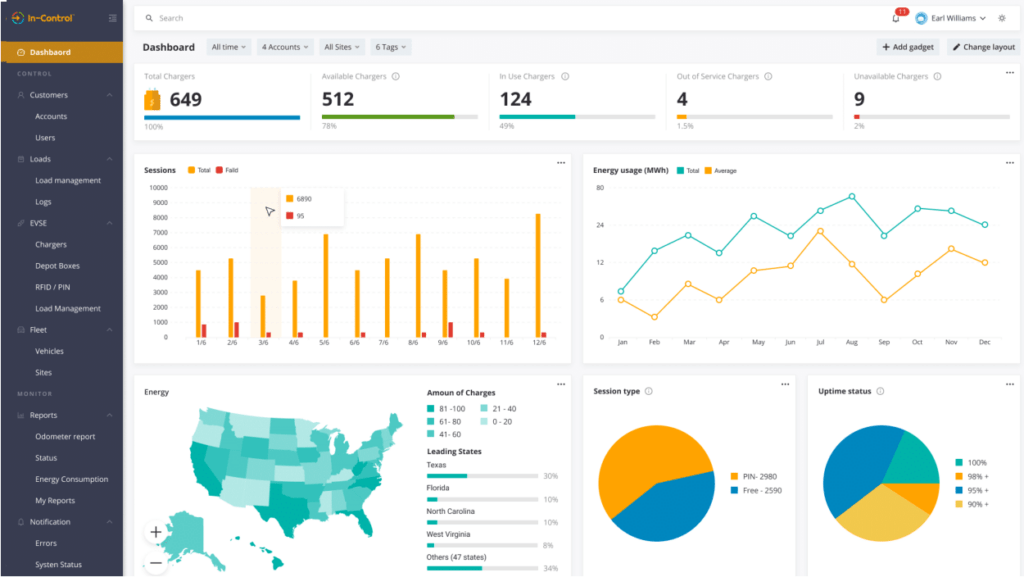
Analytics & Operator Dashboards

At-a-glance operational dashboards built for site managers and CPO operations teams — uptime trending, session analytics, energy throughput, revenue forecasting.

Analytics · Reporting · BI

Featured engagement

An ultimate management platform for EV charging operators.

InCharge Energy 4+ years Elixir · Go · DevOps
37%
Energy consumption efficiency
100k+
Connected devices
>80%
Energy efficiency improvement
Read the full case study →
SYSTEM HEALTH · ABSTRACT VIEW
Network activity
Session distribution
Throughput vs capacity
80%+
Efficiency gain

Standards & protocols

We speak the languages of the grid.

Modern EV infrastructure is held together by a handful of protocols — get them wrong, and your roaming, billing and interoperability stops working. We've implemented all of them in production.

01
OCPP 1.6 · 2.0.1 · 2.1

Open Charge Point Protocol — full spec coverage across legacy and current versions, including security extensions and ISO 15118 device bridging.

02
ISO 15118

Plug-and-charge, bidirectional energy transfer (V2G), high-level communication between EV and charger over PLC and WiFi.

03
OCPI

Open Charge Point Interface — roaming between operators, session reconciliation across networks, e-mobility service provider integrations.

04
OICP

Open InterCharge Protocol — Hubject-compatible roaming for European charge-point operators and mobility service providers.

05
OpenADR

Demand response integration with grid operators and utilities — automated load curtailment, real-time pricing signals, DER coordination.

06
IEC 61850 & 60870

Substation automation and SCADA telemetry — for clients who integrate charging assets directly into utility operations.

07
SOC 2 · ISO 27001

Compliance-grade architecture from day one — audit logs, encryption at rest and in transit, role-based access, GDPR controls.

08
MQTT · CoAP · LwM2M

IoT transport protocols underneath the charge-point layer — when your hardware partners ship with non-standard firmware stacks.

Why operators come to us

Six things our long-term EV partners stop worrying about.

The boring infrastructure problems that keep CPOs and energy operators awake at night — eventually solved, then engineered out of existence.

01

Energy consumption that pays for itself

Smart charging algorithms and remote energy monitoring optimize consumption automatically — independent of operator, season or grid conditions. Architectural choices that compound into measurable cost reductions year over year.

02

Lower R&D cost as you scale

A platform engineered correctly the first time stays cheap to run. Most of our long-term EV clients see 30–60% infrastructure cost reduction once we re-architect for load patterns that survive the next 10× of growth.

03

Remote control over distributed assets

Charging infrastructure spread across cities, sites and countries — controllable from a single operations interface. We eliminate the manual-touch operations that don't scale beyond your first thousand stations.

04

Risk management built into the architecture

Health checks, predictive maintenance signals, anomaly detection on telemetry streams. Issues surface in dashboards before they become incidents — before customer-visible failures, not after.

05

Security and compliance, by design

SOC 2, ISO 27001 and GDPR controls applied at the architecture level rather than retrofitted before due diligence. Audit logs, encryption, role-based access — engineered into the data layer, not bolted on later.

06

An interface operators actually want to use

Operations dashboards designed for the people who run the network — site managers, dispatch teams, billing operations. Clear hierarchies, sensible defaults, minimal training time.

Client voices

Words from the operators we've grown with.

"

Wellnuts built our entire EV charging management portal from the ground up — key functional modules, server architecture, UI. We've been working together for over four years, and the team continues to provide ongoing support and expand our system. We highly recommend Wellnuts as a reliable IT partner.

SA
Serge Ahranovich
VP of Engineering · InCharge Energy
"

We hired Wellnuts to optimize our EV charging load management functionality and were completely satisfied with the partnership. The team provided us with in-depth consultation and valuable advice. We liked their communication and responsible approach to the working process.

NG
Nick Gusser
CTO · Transinet

Frequently asked questions

EV charging software — answered.

If your question isn't here, ask it directly — a senior engineer responds, not a sales team.

What EV charging software do you develop?
We build the backend for charge-point networks — OCPP and ISO 15118 normalization, telemetry ingestion, smart charging, multi-payment, operator dashboards, and the analytics layer underneath. Every project is engineered to scale with the operator from regional to national networks.
Can you integrate with OCPP 2.1 and ISO 15118?
Yes — we've shipped both, in production, across heterogeneous hardware. OCPP 1.6 / 2.0.1 / 2.1 with security extensions, ISO 15118 plug-and-charge and bidirectional V2G. We normalize across vendors so your platform doesn't carry the divergence.
How do you handle scaling for charging spikes?
We architect EV platforms on Elixir/OTP and Go — the same primitives that power systems handling millions of concurrent events. Peak hours, fleet onboarding events and ratepayer surges are routine traffic, not outages.
Do you support SOC 2 and GDPR compliance?
Yes — compliance applied at the architecture level rather than retrofitted before due diligence. Audit logs, encryption at rest and in transit, role-based access, data-subject controls — engineered into the data layer.
How much does an EV platform build typically cost?
It depends on scope, regulatory footprint and integration surface. We start every engagement with a 1–2 week Discovery — at no charge — that produces a written architectural assessment and a sized estimate before any contract.

Ready to discuss your EV platform?

Tell us what you're operating, where the system is bending under load, and what scale looks like in twelve months. A senior engineer will write you back within two business days.

14
Years in practice
5+
Avg partnership yrs

Recognized by Clutch

Top IoT Developer Companies — California Top Web Developers — Los Angeles

HubSpot form (portal 242984681, form ba6582dd-2a5a-4698-8d78-3ddcc471cb4e) — loads on the client.

We work with a deliberate roster of clients each year. If we're not the right fit, we'll tell you — and point you somewhere that is.